

When I began using Dropbox years ago to manage my phone’s photos, I was happy to see Dropbox names them with their timestamp. This is how it should be, since photos are a slice of time.
In early December 2004 I recorded an interview around my Cable Project where I said I wanted to be a time travel artist. I recalled this around the interview’s twentieth anniversary, but enough time had passed that I was no longer sure what I had meant by that. I also found myself more materially capable of executing things I didn’t have the capacity for at the time, so I also wondered if there were project ideas from then I could now accomplish. Trying to reconstruct the thinking was an exercise in personal archaeology. So much time had passed that it felt like investigating the intentions of a stranger.
I remember a conversation I had while driving to Montreal in July 2003, when I described a dream project that would have consisted in redressing and restocking one of the Victorian storefronts on Toronto’s Queen St West as it would have been a century before. This was based on something half-remembered and hazy, but evocative and I thought worth exploring. Around fifteen years earlier I’d read an article in Omni magazine describing a time-travel method which consisted of merely convincing someone they were in another time through a precise recreation of an environment. By the time of the interview eighteen months later, I had tracked down what the Omni writer had been describing. It referred to the 1970 novel Time and Again by Jack Finney. I had ordered it and begun reading it. The story argued that the only thing that kept us locked to a particular time was mental familiarity with the present, but if one could be hypnotized into believing another reality was what to expect, one would find themselves in that time. This method was used ten years later in the 1980 movie Somewhere in Time. I only got a quarter of the way through the novel before putting it aside for nineteen years and taking it up again in 2023. I found a photograph that had been used as a bookmark for two decades, adding to its aura. I only saw Somewhere in Time for the first time when it was on TCM at the end of July.
So, at the end of 2024, I remembered wanting to be a time travel artist twenty years before, and I had read the novel a year prior. The questions of what I had been thinking still bounced around in the back of my mind. But by this point I’d engaged in some “twenty years later” projects, mainly beginning in 2018 when I rephotographed St. James Park and King St East to recreate photos I had taken in December 1998. But in 2007, I had decided to rephotograph Bloor Street’s Mink Mile based on photos I had taken in 2002. That became a project to rephotograph the locations every five years on December 13th, the date of the 2002 originals. That project’s twentieth anniversary had passed in 2022.
Coincidentally at this time, the Bob Dylan biopic was in theatres and in January 2025 I saw an article1 on the reconstruction of Dylan’s early 1960s apartment. This instantly sent me on a spiral. For one thing, I’d given up the idea of the dream project after I realized set dressers recreated past environments all the time. In the summer of 2004, the Ron Howard-directed movie Cinderella Man was filmed in Toronto and they used the Richmond St side of The Bay (between Yonge and Bay Streets) as Madison Square Garden circa 1935. Later, in 2006, Ron Howard impressed me again with the sequence in The Da Vinci Code where they dissolved 2006-era Westminster to Newton’s funeral and I was like, oh my god. Learn to code bud.
I read the Bob Dylan apartment article with interest, marvelling at the photos shown there. They had invested in an absurd attention to detail which is typical of the film industry's lack of proportion and yet understandable because a film is forever. It made me find an old blog post where someone had visited Dylan's apartment in 2013. It raised the aesthetic and artistic questions I was thinking of twenty years earlier; how would Dylan himself feel to walk around the set? How did the meticulous recreation of a casual circa 1963 environment affect the actors and the crew? Could Chalamet have hit his head and woken up in 1964 NYC, hypnotized into the past like the conceit of Time and Again and Somewhere in Time?
And yet, there was also something nauseating about it. Environments turned into shrines of genius from a dead world. Fundamentally, the Dylan set emphasized how such installations are mundane for the film industry and are by their nature superficial. Had I recreated a Victorian shop from a century before it would have been boring.
Saint John Henry Newman’s rooms are preserved at the Birmingham Oratory, seemingly waiting for his resurrection on Doomsday and yet what is this museum to us but a reminder that we live in Newman’s future? Dylan’s set could easily have been given a permanent home in a museum just like Francis Bacon’s studio, which was documented by archaeologists and reconstructed in Dublin’s Hugh Lane Art Gallery. For obvious reasons when I learned about Bacon’s preserved studio around 2006 I was enthralled, and yet such shrines to genius just show us that we live with materially better stuff.
*
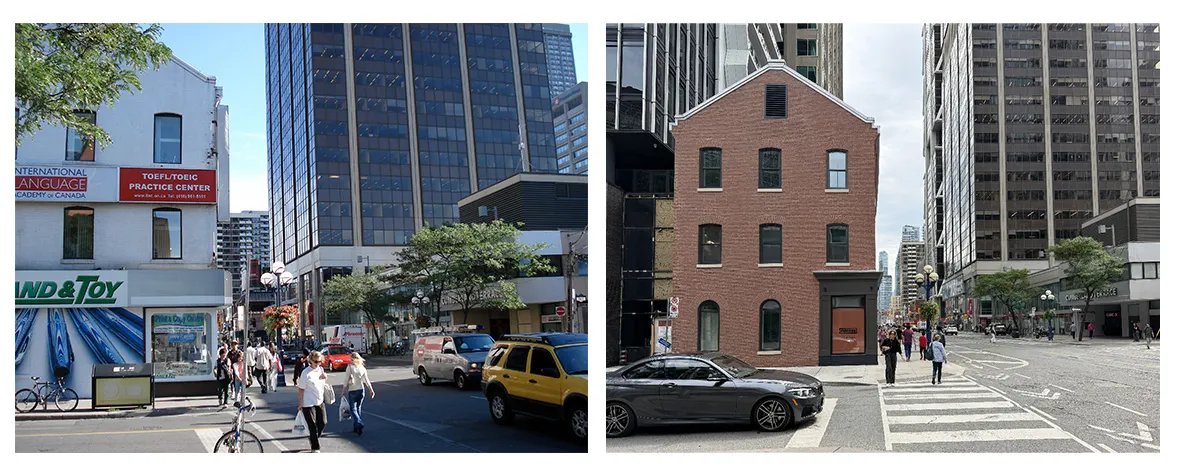
By the summer of 2006 I’d grown dismayed by how visually drab Toronto was, noticing that many vanishing point sight-lines converged on something grey and depressing. On a walk from the Reference Library to Lisgar St I took photos of examples. I called it The Ugly Toronto Series. I took the photos on August 31st 2006. This year’s August 31st was foggy and rainy, so I waited until September 4th to revisit the scenes. Going out with 20-year-old photos loaded on the phone through an OpenAI Codex vibe-coded website (a precursor to the one publicly released) I found the spots where I stood twenty years earlier. Such an exercise immediately recontextualizes the city. You look at the photo, and you look at the scene in front of you and now you have a reason to notice the trees. There are leaves everywhere, the city was a lot plainer in 2006. The original photos were taken on a Thursday evening between 5 and 7 PM and on this Friday afternoon there were people everywhere, visual evidence that the population had increased by two million. Because of the increased tree cover, sight lines now often converge on something green. The “grey sightlines” in 2006 described concrete and reflective glass but now some buildings have been painted dark grey. There is a fashion for black trim. The colour cacophony we used to get from arbitrary signage now seems to be corralled into white lettering against that black trim. A building across from the Reference Library used to be painted white and festooned with signs and is now stripped to its naked brick, signalling that we are no longer embarrassed by Victorian architecture but recognize it as something classy. Its exposed surface is the architectural equivalent of a Playboy centrefold.
A sense I get now when I do this type of work, is that people from the past are probably happy to be dead. If anyone in the afterlife was given the opportunity to visit the contemporary world and check in on how things have turned out, they would likely be horrified and disgusted, anxious to return. I imagine them having a meltdown, “Put me back! Put me back!” What would Saint John Henry Newman encounter in his old rooms but a reminder that so much time has passed, everything is tawdry and dust-covered, the life it once held is long gone. Wouldn’t Dylan, walking around the film set, just be reminded that his youth was a very long time ago?
I was taught Installation Art was an extension of sculpture, but I’d seen enough of it in person by 2005 to understand pragmatically that it was set design. It suggested the theatricality of our lives, which Instagram and TikTok later made explicit. Which is to say the old separation between art and life became increasingly blurred once theatre entered the home through television in the 1950s. The Boomers in turn described themselves as TV Babies and they wanted their lives to be TV shows. For example, the argument has been made that Trump’s shtick is that he only wants to play the president on TV, not actually do the job2. AA Bronson essentially argued that this theatrical understanding of everyday life was part of the motivation for the development of video art in his 1983 essay The Humiliation of the Bureaucrat. In this rough genealogy, Installation Art brought set design out of the playhouse, suggesting theatre could also exist outside of the stage. The externalization of theatre into everyday life. In the 1970s they imagined pocket calculators, but thirty years later they imagined pocket television studios. Has anyone ever questioned why phones became media devices in the first place?
That, in turn, allowed me, in my own way, to take over 700 photos when I rephotographed the 59 I took in late August 2006. The democratization of image making is a genuine marvel. And when I do my walks twenty years after the fact, the photograph becomes an instrument of seeing what’s directly in front of me. I’m reminded of a line written by Donald Kuspit in a 1999 review of Old Master work: “superior skill enhances sight so that it becomes insight”. That line struck me like lightning when I first read it twenty-one years ago, and I’ve remembered it all these years. But looking it up now, I see I slightly misremember it, showing how the past is nebulous until we are confronted by its evidence3.
The old photos enhance my sight and become insight. The trees are bigger, there are more of them, the city has more people, this building had its paint removed and that one had paint added. There are new towers. An insight I had doing these projects is that I use the twenty-year interval because I grew up in the 1980s which was then obsessed with the 1960s. The '80s were full of twenty-year anniversaries celebrated on TV. Fucking Woodstock, my god. Only we make ceremonies for the quarter century mark, so Woodstock 94 happened. And I write this around the 25th anniversary of Nine Eleven.
*
A couple of years after the towers came down, I spent a week keeping track of how many times I heard “nine eleven” or “September eleven” because it had become ubiquitous. It’s also why I buck convention and refuse to write it the usual way. The nine-slash-eleven glyph is its own semiotic. On that very Tuesday reporters put microphones in front of people on New York streets and people kept saying, “it’s just like a movie”. I was with it enough to see a dreadful future, knowing America would do something terrible in response and make an actual fucking movie about it one day. In the years since, characters show up at the World Trade Centre on a blue-sky September morning as a plot reveal. Time travellers arriving in August 2001 would not be showing up to watch a baseball game. Actual time travel conceits mean Travellers are arriving for a show. The postmodern condition has long questioned whether the presence of a camera causes people to perform for it. The falling tree doesn’t make a sound in the forest if there’s no one to hear it. The tree puts on make-up and faints dramatically when the camera is there to record it. Twenty-five years ago, people were well aware that flying planes into the World Trade Centre was meant to be spectacular.
If the camera implies an audience and creates self-consciousness, the imaginary time travellers carry the parcel of knowledge that they are the audience. Stephen Hawking once invited time travellers to a party, and no one showed up. This implies that time travel will never be real. But maybe the time travellers realized there’s no point showing up to something when everyone knows why you’re there. The past is the future’s movie, and the time traveller shows up for the theatre of real life.
*
I first read William Gibson’s Neuromancer thirty years ago in the summer before I began studying at NSCAD. His novels and my art education intertwined, the aesthetics of cyberpunk overlapping with the late 1990s postmodern that I saw in Radiohead album covers by Stanley Donwood. In the late 1990s CityTV would play Blade Runner after the midnight celebrations of December 31st, so I taped it at the beginning of 1998 while in Toronto for Christmas. So, I remember 1998 especially as a fusion of cyberpunk and the postmodern, but because it was all centred on The Future, I would walk around Halifax imagining what it might become.
I look back now and see clearly how The Future was a 1990s cultural affectation driven by the looming Millennium. It seems the whole decade looked forward to the year 2000 and the 21st Century. In 1989 I marvelled about how 2015 had been depicted in Back to the Future Part Two. I had grown up with countless films and TV shows set in the near or far future, all of which look ridiculous now that we’ve outlived what was imagined. In 1973, Soylent Green was people before it became a supplement forty years later. That movie is a wonderful example of how the future is imagined as looking like the present. Soylent Green‘s 2022 looks like 1973 with too many people. In turn, our movies set in the future just show us what the world looks like today with equally questionable demographics.
By the end of the 1990s I’d developed an understanding of how film set design used speculative and under-promoted industrial design and the two seemed synchronized so that new products could be marketed by inclusion in a movie. For example, I remember buying woodless pencils after seeing them in the film Bicentennial Man.
So, I’d walk around Halifax and try to imagine what it would become. And then, in 2019 I visited. It had been twenty years. I drove into the city in a rented car with some hours to kill before my flight back to Toronto and parked in my old neighbourhood. Between 1997 and 1999 I lived on Queen St, and I walked to my old doorway. Across the street Alexandra’s Pizza was still there, although with signs saying they’d be moving soon. I broke down the experience into what was actually occurring, drawing on high school biology and physics. The light was reflecting off the pizza shop and hitting my retinas, for the first time in twenty years. I was seeing the exact same thing I saw then routinely only now my mind was filled with two more decades of memory, reading, thought. My body was thirty pounds heavier. From that doorway I redid my walk to NSCAD; Queen to Spring Garden, to Pizza Corner, along Argyle. I have a favourite tree in the Grand Parade. I found the sight of the Rogers sign at Pizza Corner repellent, but it made me realize I was living the dream of twenty-one years before. It looked ridiculous but also was the type of CGI future shit that would have been added to the cityscape if a sci-fi movie had been made in the 1990s.
When I was a student, I would occasionally have nightmares where I was out in the city, but something felt dreadfully off. I remembered this as I walked around because I was experiencing a city where things were very off because it was twenty years in the future.
William Gibson’s Count Zero especially resonated with me in 1998 because of its artworld plotline. A former gallery owner was hired to track down the manufacturer of Joseph Cornell-like art boxes. I borrowed Cornell monographs from the library to read in coffee shops.
So I was stunned, late last year, when I learned Wes Anderson had recreated Joseph Cornell’s basement studio in Paris. Twenty-five years ago, I imagined an installation recreating a past environment and recognized how that was routine in the film industry. Now a director had used that facility to recreate the studio of a maker of dioramas as a diorama itself. Worse, it was set up as a window display at Christmastime, a deliberate echo of the department store installations of the 20th century4. Department stores set up a Christmas world theatre to entice shoppers and delight children. Cornell had set up theatrical worlds in the confined space of a storage box. Now the film maker - who makes theatre for the box of the cinema - brought the theatre out of the playhouse and gave it an imprimatur of art world certification, with a title, and exhibition dates, and a location.

The House on Utopia Parkway Joseph Cornell’s Studio Re-Created by Wes Anderson December 16, 2025–March 14, 2026 9 rue de Castiglione, Paris • Gagosian Gallery
Eugene Atget died ninety-nine years ago after documenting Paris in photography for forty years. I saw an exhibition of his at the AGO in 2001, and that showed me what could be done with photography at the beginning of a long-anticipated century, a blank canvas of History waiting to be lived through. The time travellers would show up in 6 months to witness the symbolic end of the 20th Century. I attended a lecture during the exhibition and the speaker argued that Atget was a real photographer because he revisited some spots. That made an impression because I didn’t understand why that mattered. For that matter, twenty-five years of using photography for projects and I don’t consider myself a photographer because they have a culture around equipment that I don’t care for. I like the pedestrian, everyday image of a snapshot. Atget’s Wikipedia entry has this sub-headline: “Atget’s photographs: the problem of the work of art”. Jesus who cares. It feels like the professional culturati spend so much energy gatekeeping that it constitutes the actual cultural production. Oh, what do you do? I’m a gatekeeper. Sip of wine.
They’re letting in the set design now. They are allowing the meticulous recreation of past environments.
I wouldn’t say Atget directly inspired my photographic projects over the past quarter century, but he made me aware of what could be done. The true seed to these works dates to the end of 2002 when I left the ROM and walked along Bloor St and recognized the window displays as prequel echoes of what I’d just seen at the museum. The ROM has an 18th Century recreated room painted in a particular green, and here down the street is Prada in its trademarked green. The December 13 2002 photos where already on my hard drive so I compiled my thoughts into a booklet called The Time Traveler of the Future Stands Amazed.

And now from the perspective of The Future, I’m amazed at how the reconstruction - a postmodern tableau we find in cosplay and LARPing and the live action museum environment - is an attempt to make the past real. But perceiving the change through before and after photos is a gut-punch that makes you aware of the stream of Time itself.
I made work for imagined time travellers using time stamps and geo-coordinates to give them a target to visit, but the only real time travellers are our aging selves. The audience isn’t born yet because Posterity is the audience. Art is one of the few things that communicates across the temporal plane, and I am attempting to converse with a future I won’t live to see.
As much as I dreamed of time travel in my youth, both forward and backward in time, at middle age I’ve come to understand that it wouldn’t be fun to do either way. I think I dreamed of bringing the past into the present twenty-five years ago because I wanted more perspective than what my biological age allowed. I wanted to travel to the future because I was curious about how the story would unfold. In middle age I understand that twenty years is not a lot of time in memory, so I comprehend why the 1960s was so prominent in my youth. Twenty years is a sneeze. But having witnessed it I also have an instinct now that the future will be strange, and that aging is a process of accumulated alienation. At fourteen, Back to the Future’s colourful Californian 2015 made me very curious about what the year would turn out to be like. The imagined future sci-fi I really appreciate now is the stuff that leans into the strangeness. There’s an episode of the Apple TV series Extrapolations that I think of now when I consider this. The world it depicted for the year 2066 was so strange and awful I realized that if I survive, I’ll be 91 and looking forward to death, so alienated by what the world has become. This causes me to reflect on the deaths of elderly celebrities who disappeared from the media cycle long ago. I get it now, I understand why people disappear into private lives. There’s something in the word ‘retirement’ that for me means giving up and checking out. I feel like I retired from the art world I was a part of twenty years ago.
And by looking forward to death, I don’t mean something depressed or suicidal. Near the end of his life William F Buckley expressed as much in interviews. We visit for a time, and then we are tired and want to leave and never return.
The Extrapolations 2066 episode depicts a time when people hire actors to stand in for someone they lost; an ex-boyfriend, a missing husband or a dead son. It shows a world where the recreation of the past is a coping mechanism for mourning. I watch it and find it repugnant because the past is not supposed to take up so much space. Extrapolations speculates about our climate-change future, suggesting that we’ll lose so much in this century that forty years from now we’ll have adapted theatre to artificially keep alive what has been lost.
Maybe it’s important to state that digital media is wonderfully malleable and there’s no reason to be precious about it. Perhaps my old photos will one day be overlaid on augmented reality glasses that haven’t yet been invented. Perhaps one day the photos will be available to generate Gaussian splats in a Holodeck-like space, allowing someone to step into the scenes. That, in the end, would draw the full circle. I experience the art as the perception of time, rather than its recreation, but maybe that’s a product of being middle-aged. Maybe the kids will need the recreation. If the Holodeck recreation is valuable to young people in the 22nd Century, who am I to judge? But if the middle-aged stand in the room and ask the system to morph one archival photo into the other, allowing for the change to be animated and visible, that would be possible as well.
So being a time travel artist, in the end, is not to recreate the past. It is to make the past legible through documentation, and to provide a trace that can be overlaid on the present under special conditions. At this point I take photos, timestamped by Dropbox, and use my learned-to-code skills to make documentary websites. Websites are the medium I work in. The gatekeepers haven’t let them in yet. This is the baton being passed for this leg of the journey. At some point in the future maybe the material will be taken up again and reformatted for whatever media experience is then available.
House Beautiful (2024-12-25); Indie Wire (2025-01-09)
I’m especially thinking of The Daily Beast podcast of 2025-12-25
The actual line is “For superior craft intensifies sight so that it becomes insight, which is what occurs in highly crafted Old Master art.” and is from Going Going Gone (1999-09-15); I encountered it in 2005 and included it my Goodreads mailing list on 2005-06-08
However, Joseph Cornell routinely held is exhibitions in December because his birthday was Christmas Eve, so the Christmas association has always been there with Cornell