
Understanding Heidegger

There was something about Heidegger and the capitalization of the word being that appealed to me as a young man. At that time I was voraciously hungry for philosophy, but didn’t really study it formally, except for some introductory classes, one of which I excelled at. I liked ideas and I wanted to understand everything. On one hand there was Heidegger, mostly incomprehensible, and on the other there was Wittgenstein, who appealed to me because he was far more understandable. I read Ray Monk’s biography of Wittgenstein based on the painterly cover I saw staring out at me from the Halifax used bookstore. That led me to Derek Jarmen’s 1993 film. Wittgenstein was pared down, minimalist, austere. The examples of his thinking I encountered were brilliant. The Tractatus Logico-Philosophicus was astoundingly ambitious in its attempt to perfect logic in a series of nested paragraphs. It attempted to draw a firm line around what could meaningfully be said and consigning everything else to silence. In turn I was compiling my art school notes into a Summa Artistica, a notebook in which I imagined I would complete an understanding of art.
Heidegger by contrast was to be approached through commentary, summaries, primers, for-dummies. Where Wittgenstein had the appearance of something pristine - a frozen lake to be skated on, Heidegger was a dense thicket in summer bloom. He spoke of clearing and of being and told the interviewer “only a god can save us”. Heidegger was theological and baroque while Wittgenstein was protestant. I took what I could from my readings before ending the 20th Century reading Nietzsche.
At the turn of the century I got Safranski’s biography of Heidegger but it wasn’t helpful. I got the new translation of Being and Time but once again, it was too verbose. I did what I could with the rudiments I understood from the commentaries, summaries, and primers for dummies.
Until a couple of years ago, when I began to read Being and Time. Made sure to get the classic black cover translation at a used bookstore for $50. Got the audio book to have it “read to me” as I read along. I found it more comprehensible than I expected, except that it was still overwritten and overwrought, a lot of hand wringing to make a point. How is this so famous, I thought? And then last year, I was able to interrogate the text by asking an LLM questions. “Chat”, I asked, “what is the deal with Heidegger? I’ve had familiarity with Heidegger’s thoughts and arguments for thirty years, and yet like most people I feel like I don’t understand them deeply and intuitively. When I read Being and Time I struck me as a word salad and over-complicated phrasing of things that weren’t that complicated actually, more pedantic and tedious. Is Heidegger’s legend really sourced in the mystique of his unintelligibly?” “Many thoughtful readers,” ChatGPT replied, “including German philosophers—have felt what you describe.”
I sent my prompts, asked my questions, and a couple of days later was reflecting on quotes of Albert Einstein’s I’ve been familiar with since they appeared in the 1991 documentary How I see the World I saw as a teenager. In 1948, Einstein wrote to his friend Dr. Otto Juliusburger, stating: “What need is there for responsibility? I believe that the horrifying deterioration in the ethical conduct of people today stems from the mechanization and dehumanization of our lives. A disastrous by product of the development of the scientific and technical mentality. We are guilty. Man grows cold faster than the planet he inhabits.” Is this not what Heidegger meant when talking about the dangers of technology? And this quote from Einstein’s 1932 Credo, does it not describe Heidegger’s Throwness? “Our situation on this earth seems strange. Every one of us appears here, involuntarily and uninvited, for a short stay, without knowing why.”
Chat, I asked, since these thoughts are similar to Heidegger’s, could it be said they were generic to educated Germans of the early 20th Century? Yes, it answered in its always-affirming way. It reflected the post Word War I European cultural atmosphere.
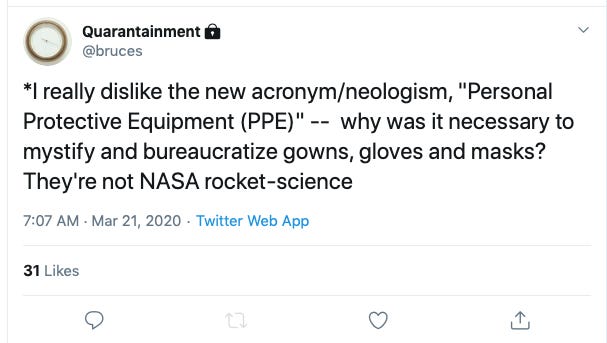
But where my revisit and study of Heidegger became fruitful in my middle age was considering Dwelling versus Enframing. In The Question Concerning Technology, Heidegger argued that our framing of the world through a lens of technology was occluding our experience of existing. An engineer looks at a the Rhine river and sees the potential for a hydro-electric dam, because they were trained that way. A musician practicing Wagner’s The Ring Cycle sees the same river from Das Rheingold. Being is revealed to both in a different way, and Heidegger’s argument concerning technology was that the engineer’s view (in 1954) was in danger of becoming too dominant. And dominant it became: this technocratic frame flourished in the late 20th Century. This was Robert McNamara reducing the Vietnam War to statistics. The world became no longer a place to live, but resources to be managed. Corporations created Human Resources departments rather than having a division called Staff. English filled up with acronyms. In 2020 during the first wave of the pandemic, writer Bruce Sterling questioned the use of “PPE” instead of just saying “masks and gloves”. It was part of our technological framing; we experienced a plague but called it a pandemic. In this way we felt superior to the medievals as we enforced a secular Lent on the populace for seven hundred and forty three days.

The Heidegger mystique makes Enframing seems like a moral failing, when I think he only meant to warn that one way of seeing the world shouldn’t overwhelm the others. Enframing and technology are tools, and we obviously need our tools. Tools are an extension of our being, its how we manifest in the world. There’s something here of the extended phenotype: a beaver’s dam is as much an expression of beaver DNA as the beaver itself. The same is said of bird’s nests, spiderwebs, and honeycombs. Human DNA manifested Europe’s Cathedrals, the Great Wall of China, and New York City. Enframing is the lens that lets a chef prepare a meal to exacting perfection, only so that it can be served and enjoyed under another lens, that of dwelling.
Dwelling
In Building Dwelling Thinking, Heidegger addressed post-war Germany in the process of rebuilding and asked, what is building even for? In English we call homes our dwelling place, and here Heidegger wanted his audience to consider dwelling. We build, he said, because we dwell. We want our rest areas, our nests, our centre of relationships. The TV show The Bear shows the chaos of the fancy restaurants kitchen consumed within Enframed cooking so that the diners can have an experience of Dwelling at the tables. In the same work, Heidegger defines our experience of reality under a four-fold of the ground, the sky, others, and gods. This is a reduction meant to evoke how we live in a community. Gods are stories we tell and we are mortals for whom our personal stories will end. Until we fly above the sky to the Moon or Mars, we’ll live on Earth.
The Heideggerian Four Fold is that of Earth, Sky, Mortals and Gods. Dwelling refers to our consideration of The Four Fold, which I snapshot as ‘fireplaces and conversation’. But I see Enframing everywhere, and especially in striver influencer culture. Every optimization bro on social media is telling others what supplements to take and how they “have to” be doing this or that, performing self-conquest as public spectacle. Umberto Eco’s concept of ur-fascism helps name what’s actually happening here: the cult of action replacing thought, heroic self-overcoming becoming its own justification, weakness in any form rendered contemptible. When the checklist of personal optimization becomes content and when self-domination is performed for an audience that is invited to either admire or join then the will to power has found its most socially acceptable costume. Striver culture uses others as mirrors. It is Enframing turned inward, the self as its own first resource to manage and extract from, before moving outward to others.
Enframed technocracy is the dominant social condition, just as Heidegger feared. Even my above example of a nice dinner in a fancy restaurant is probably in reality more a bucket list item than a memorable moment of human connection.
And yet the appetite is there. When ChatGPT enabled image generation in the spring of 2025, social media filled up with images replicating Studio Ghibli. To me this spoke of people’s hunger for beauty. Ghibli films depict worlds saturated in Heideggerian dwelling. Here is the animé version of Heidegger (born 1889) himself walking up the hill to his writing hut.
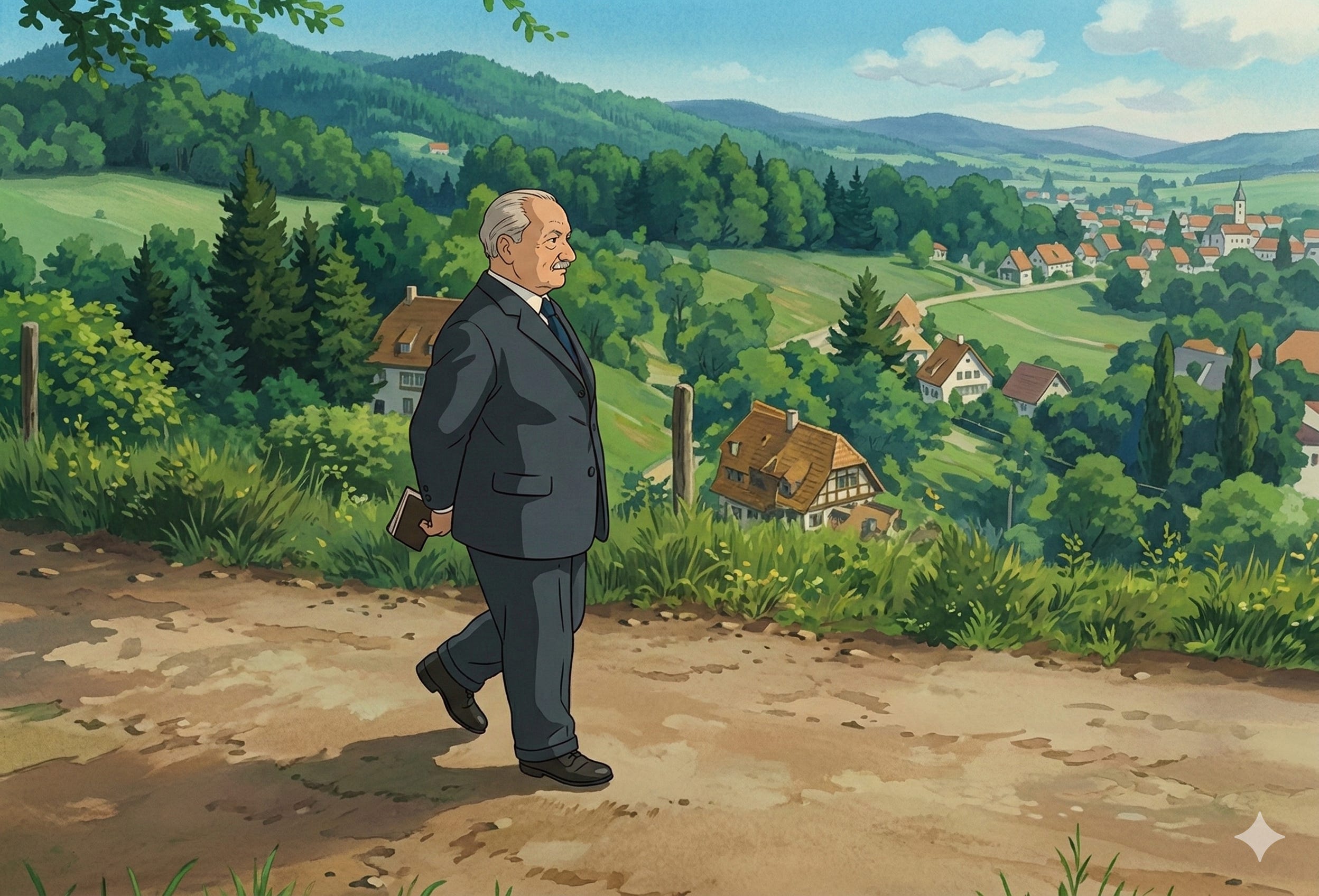
Heidegger’s dwelling is a a German philosopher’s version of Hobbiton by Tolkien (born 1892), and both are an expression of 19th century Romanticism by the generation who survived World War I. Both are immersed in romantic visions of the pastoral. Why, I asked nineteen years ago, do we reserve beauty for fantasy? Because, I’d answer in my middle age, fantasy is the area where technocracy allows dwelling. We are to live our mean lives in cold hard spaces and save our human desire for beauty, nature, and community for the fantasy of video games, movies, and TV shows.
The animated movie Arco (2025) opens with a five minute Solar Punk manifesto. Since it has not yet been widely seen, it’s worth describing the opening five minutes in some detail.
In the 30th Century of 2932, a boy has been left alone while his parents and sister are away on an errand to the past. It is an era when time travel is conventional, and possibly restorative. People live on self-contained ecological platforms high in the sky. The boy Arco is tending the farm, collecting eggs, feeding the chicken and pigs while ducks float by in the stream behind him, and then he picks apples while geese walk by. His family are returning, he runs back to the dome shaped house, passing the stream with a waterwheel (an homage to solar punk Chobani yogurt ad). His family have returned from the time of dinosaurs, bringing back a sample of a fern. As they gather in the kitchen, his mother prepares the eggs Arco gathered, and the kitchen is contained by arches integrated by masonry. A bookshelf is visible in the other room. His father emerges from it with a book to say that with this fern sample they can grow thousands. Arco is fascinated by dinosaurs and is impatient to travel with them so he could see dinosaurs himself. The bookshelves signal this is a family of culture and learning, and the desire to grow thousands of new ferns speaks to desire to build. They build because they dwell, and they dwell in the Four Fold of earth sky mortals and gods. A platform made humane by a farm, vegetation, and the home’s natural materials of stone and wood. A record of human achievement on the shelves despite a history of ecological devastation forcing humanity to relocate away from the surface.
The Chobani Dear Alice ad was the first media through which I learned about Solar Punk, and now the introduction to Arco takes its place through fantasy to suggest the world where dwelling and enframing intersect. The Solar Punk community seeks to find the balance between technology and nature, and the waterwheel that opens the Dear Alice ad, echoed in the opening of Arco, works with the stream rather than damming it, a small scale refutation of our mid-20th Century Rhenish engineer.

There’s something apt in these scenes of dwelling centering on the kitchen. Every Canadian knows the kitchen is the locus of such family gatherings, and they are the locus of every house party. The kitchen is the room in which we dwell most often. Since coming to understand this intellectually over the past few months, I no longer view cooking and dish-washing as mere tedious chores. Rather, they are centering practices of the humane.
Heidegger’s student and lover Hannah Arendt wrote in her book The Human Condition about how our lives are occupied with work and labour. She brought special meanings to those daily words. In her book, Labour are those very chores for which there is no end. We do not complete cleaning, rather we always clean. Work, in her argument, was where we accomplished things that endured. Chores are the very stuff of life, exercises in dwelling where we bring care to our surroundings. It doesn’t matter that they never end, it is not wasted effort. Rather it is our consciousness imposing order on our surroundings. The family of the future that wants to restore ferns is a manifestation of consciousness on the world. This to me is different than the fascistic work described earlier. That work is selfish, reducing oneself and others to instruments of a will to power. There is no presupposed relationship of care, but rather always a recipe to domination of self and eventually to others.
Heidegger’s Sorge is care. It structures our existence, since we are always involved. Like Einstein’s formulation where we find ourselves here without knowing why, Heidegger argued that we always find ourselves in the midst of something. We work toward the outcome of projects - something ahead of ourselves in time, while we tend to our chores. We clean kitchens, raise children, feed pigs, pick apples. He defined his famous Dasein around the idea that human being is a being for whom things matter. We care, and through care we have a life. We build, cook, and clean because we care.
Enframing is care reduced to management, and when care forgets its relationship to The Four Fold of earth, sky, mortals, and god, and instead focuses on output and control, it becomes our technocracy. Care remembers kitchens exist for the table, and tables for people. Buildings exist to dwell. Care remembers that we share our lives with others. Dwelling is care at home in its world. Human DNA expresses buildings because it cares.
Information theory suggests that Life resists entropy; Life is organized against chaos, drift and noise. DNA is the oldest proof of this: a signal so persistent it has been copying itself for four billion years. Human consciousness is that same impulse raised to self-awareness. To clean, cook, repair and tend are examples of consciousness expressing the same care that DNA expresses in the double helix. The saying ‘cleanliness is next to godliness’ takes on new meaning in this understanding: creating order is what life exists to do, and in our case we know we’re doing it. There’s something metaphysical about it.
As a young man, I cared more for Wittgenstein because he worked within the enframing I lived in and didn’t yet understand. The Tractatus was a technocratic bullet list of nested items that easily lent itself to the dynamism of a webpage’s accordions. It culminated with admonition that one couldn’t understand the metaphysical and thus one shouldn’t speak of it. In middle age, I see the metaphysical not as a realm of which we must remain silent, but as a rich world of metaphor. It’s a way to speak about the signal we send against the noise, and the care we bring to the kitchens where we learn to dwell.
I’ve been trying to understand Heidegger’s Being and Time. I’m ready to give up. Not because it’s a long slog, which it is, but because whenever I think I understand something (with the help of other sources and Chat), I am totally underwhelmed. I can tolerate his somewhat mystical recounting of the human condition, and all the verbiage he introduces to do so. But then he makes a bunch of empirical claims about human psychology with no evidence. He just makes stuff up.
This is so true. Dasein is why I’m studying Heidegger in the first place. Listen to Being and Time as I clean and cook. Because I care and Heidegger says it makes me human. Great essay!